> For the complete documentation index, see [llms.txt](https://docs.platform9.com/llms.txt). Markdown versions of documentation pages are available by appending `.md` to page URLs; this page is available as [Markdown](https://docs.platform9.com/managed-kubernetes/5.10/storage-introduction/persistent-volume-claims.md).
# Persistent Volume Claims
A Persistent Volume (or PV) is simply a directory on a disk that is reachable from the containers inside a pod. Persistent Volume types are implemented as plugins in Kubernetes. This allows for both physical storage devices like NFS, NAS, and SSDs or cloud-based storage types like Amazon Elastic Block Store, Google Cloud Storage, or Azure disks access to a cluster via these plugin objects. PVs are either set up manually by an administrator or dynamically allocated using [Storage Classes](https://platform9.com/docs/kubernetes/storage). It should be noted that PVs are independent of the individual Pods which utilizes them.
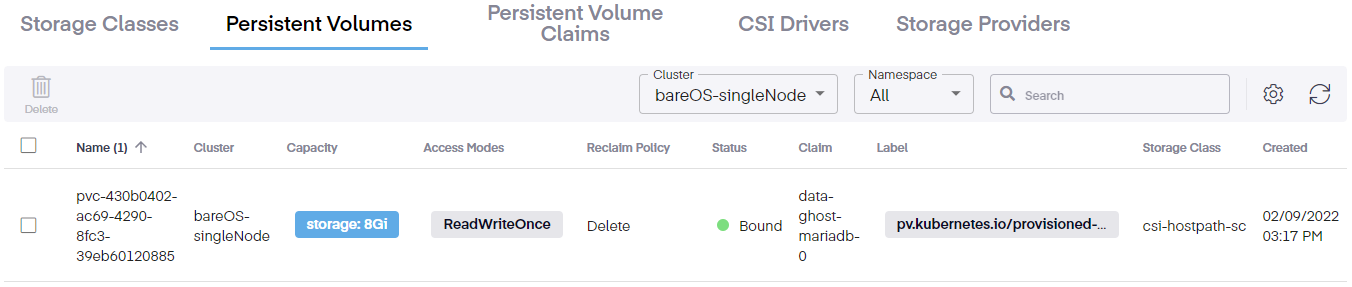
To get to this tab, go to the Storage > Persistent Volumes page. This view shows a significant amount of info about the PV.
The column data can be configured to show the following information.
* Name – The name of the volume
* Namespace – The namespace location of the PV
* Cluster – The cluster the PV is attached to
* Capacity – The amount of storage capacity provided for in the PV
* Access Modes – This field indicates the CSI drivers specs
* Reclaim Policy – The reclaim policy can be either Delete or Retain. The default setting is Delete.
* Status – Defines whether the PV is bound or unbound
* Claim – This shows whether a PV is bound
* Label – This is the field that the user defines for the PV
* Storage Class – The name of the CSI driver used in the storage class
* Created – When the PV was created
## Examples
Below is an example of a YAML file for a PV.
{% tabs %}
{% tab title="PV YAML" %}
```yaml
apiVersion: v1
kind: PersistentVolume
metadata:
name: foo-pv
spec:
storageClassName: ""
claimRef:
name: foo-pvc
namespace: foo
...
```
{% endtab %}
{% endtabs %}
---
# Agent Instructions
This documentation is published with GitBook. GitBook is the documentation platform designed so that both humans and AI agents can read, navigate, and reason over technical content effectively. Learn more at gitbook.com.
## Querying This Documentation
If you need additional information that is not directly available in this page, you can query the documentation by asking a question.
Perform an HTTP GET request on the following URL with the `ask` and `goal` query parameters:
```
GET https://docs.platform9.com/managed-kubernetes/5.10/storage-introduction/persistent-volume-claims.md?ask=&goal=
```
`ask` is the immediate question: it should be specific, self-contained, and written in natural language.
`goal` is what the user is ultimately trying to achieve, the reason they need the answer. Sharing it helps GitBook give you a better, more relevant answer. A goal is most helpful when it describes the outcome the user wants rather than restating the question. For example, with `ask=how do I create an API token`, a goal like `automate deployments from our CI pipeline` lets GitBook tailor the answer to that use case.
The response will contain a direct answer to the question and relevant excerpts and sources from the documentation.
Use this mechanism when the answer is not explicitly present in the current page, you need clarification or additional context, or you want to retrieve related documentation sections.