> For the complete documentation index, see [llms.txt](https://docs.platform9.com/llms.txt). Markdown versions of documentation pages are available by appending `.md` to page URLs; this page is available as [Markdown](https://docs.platform9.com/self-managed-cloud-platform/architecture-overview.md).
# Architecture Overview
This article describes the overall architecture for Platform9 Self Managed Cloud Platform (SMCP).
Platform9 SMCP consists of three major components that make up the product:
* **The Management Server**: This is the main element that provides component management
* **Host Components**: These are cluster elements that make management of the Kubernetes cluster possible.
* **Utilities:** The CLI that aids in setting up the management server
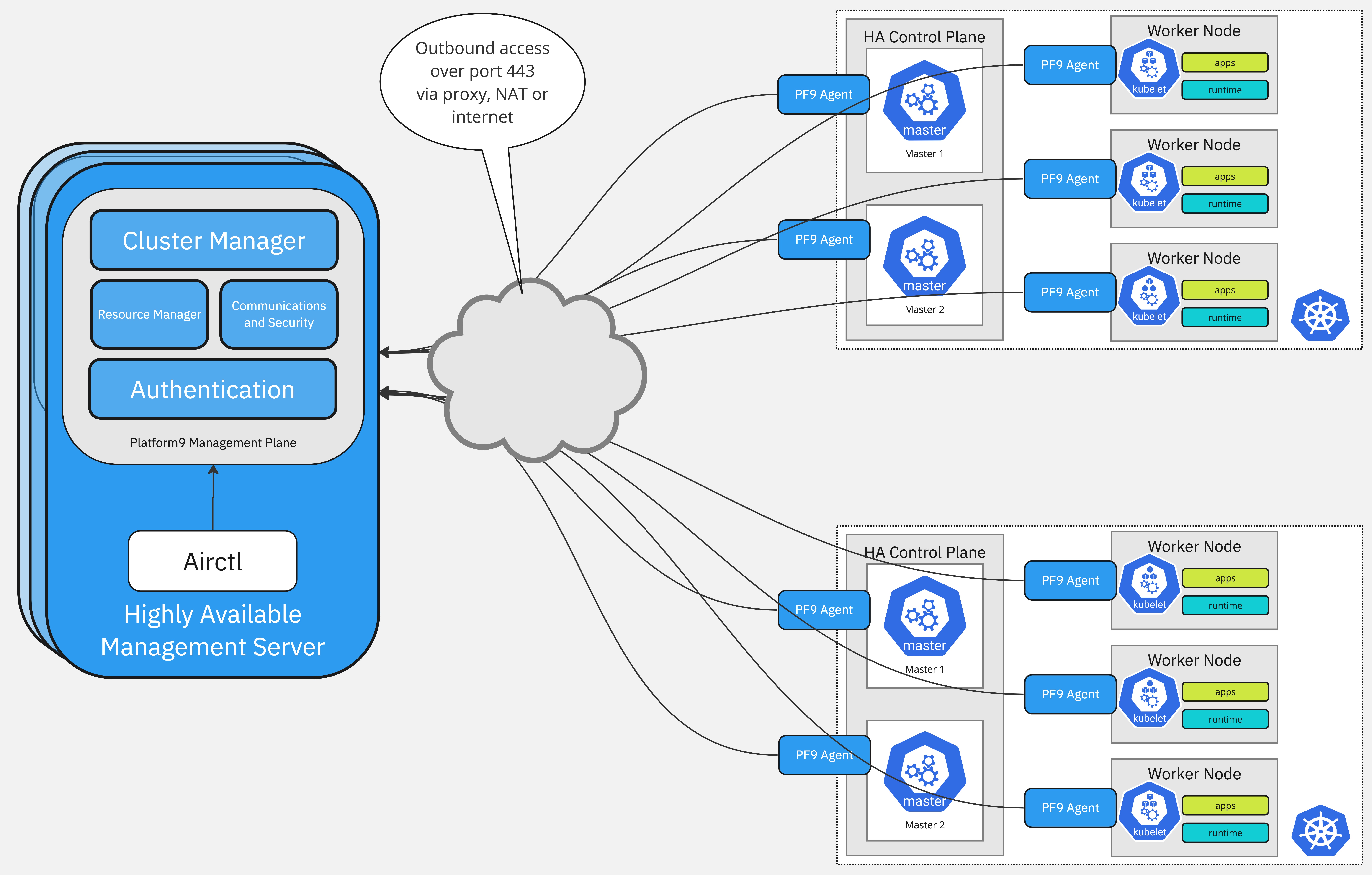
The illustration below is an approximate overview of the configured architecture. It is divided into two main types of hardware:
* A Management Cluster
* The cluster machines
## Management Cluster
One of the key prerequisite is a place to install different utilities and the management plane. A management station or deployment host assumes that responsibility. The management cluster is a machine where the management plane can run and also has the necessary connectivity from which users can access all the Kubernetes nodes. This host can be a small workstation like an Intel (Next Unit of Computing) NUC.
## The Management Plane
The **Platform9 Management Plane**, is a unit of deployment that typically represents a region for a given customer. It provides APIs for managing PMK clusters. The management plane runs as a group of containerized services on a Kubernetes cluster. The Management plane is the component that contains various functions like the following:
* Authentication services
* Cluster management services
* Host management services
* Security and tunneling services
* Data services, including message queues and databases
* Monitoring services like Grafana or Prometheus
Further details can be found on the [auto$](https://github.com/platform9/pcd-docs-gitbook/blob/main/PEC/management-plane/README.md) page.
## Cluster Components
Each management service controls one or more Kubernetes clusters, each cluster contains not only the Kubernetes services but also the services/components needed to help manage the Kubernetes cluster itself and other add-ons. These include:
* Kubernetes components like the api-server, scheduler, etcd, kubelet etc.
* CNIs: Calico, Flannel, SRIOV etc.
* Monitoring: Prometheus
* Supporting services to manage and upgrade the Kubernetes cluster.
Further details on the cluster internals can be found on the [auto$](https://github.com/platform9/pcd-docs-gitbook/blob/main/kubernetes/host-internals/README.md) and [Cluster Internals](https://github.com/platform9/pcd-docs-gitbook/blob/main/platform9-docs/5.10/kubernetes/cluster-internals/README.md) page.
---
# Agent Instructions
This documentation is published with GitBook. GitBook is the documentation platform designed so that both humans and AI agents can read, navigate, and reason over technical content effectively. Learn more at gitbook.com.
## Querying This Documentation
If you need additional information that is not directly available in this page, you can query the documentation by asking a question.
Perform an HTTP GET request on the following URL with the `ask` and `goal` query parameters:
```
GET https://docs.platform9.com/self-managed-cloud-platform/architecture-overview.md?ask=&goal=
```
`ask` is the immediate question: it should be specific, self-contained, and written in natural language.
`goal` is what the user is ultimately trying to achieve, the reason they need the answer. Sharing it helps GitBook give you a better, more relevant answer. A goal is most helpful when it describes the outcome the user wants rather than restating the question. For example, with `ask=how do I create an API token`, a goal like `automate deployments from our CI pipeline` lets GitBook tailor the answer to that use case.
The response will contain a direct answer to the question and relevant excerpts and sources from the documentation.
Use this mechanism when the answer is not explicitly present in the current page, you need clarification or additional context, or you want to retrieve related documentation sections.