> For the complete documentation index, see [llms.txt](https://docs.platform9.com/llms.txt). Markdown versions of documentation pages are available by appending `.md` to page URLs; this page is available as [Markdown](https://docs.platform9.com/private-cloud-director/2025.4/virtualized-clusters/deploying-workloads.md).
# Virtual Machines
A **virtual machine** or a VM is a software-based representation of a physical computer. A VM allows you to run an operating system and applications using the resources of a host machine or a hypervisor, acting like a separate, isolated computer with its own virtual CPU, memory, storage, and network capabilities, all managed by the hypervisor.
You can create a virtual machine by first [populating an image in the image library](/private-cloud-director/2025.4/virtualized-clusters/image-library---images.md), then creating one or more VM flavors, and then creating a new VM.
## VM Flavors
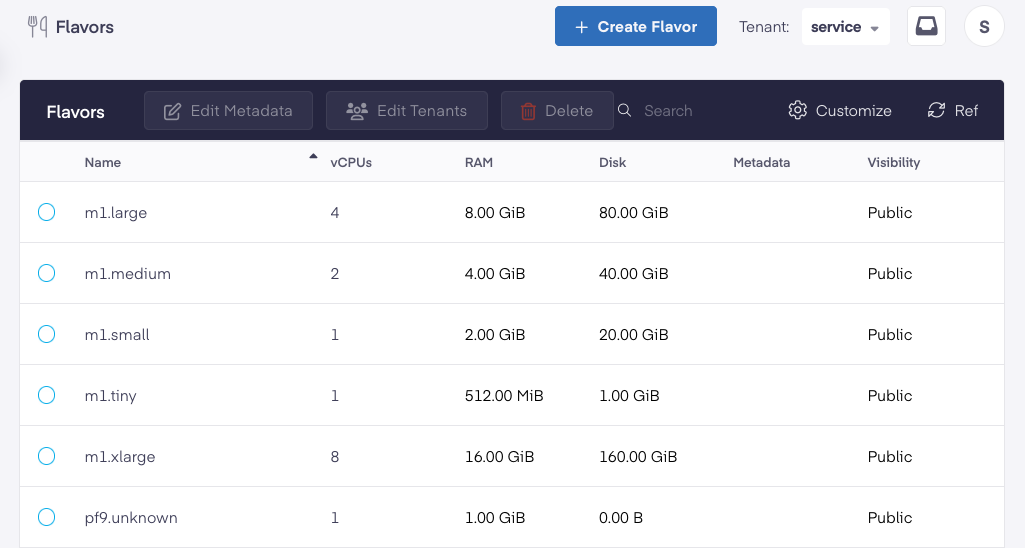
Once you have the images you would like to use, it's time to look at the resource configuration for the VMs to be deployed. space.vars.product\_name uses T-Shirt sized configurations of resource allocations, called Flavors, to allow you to specify the resource allocation for VMs. Navigate to the Flavors section of the UI and create or edit flavors to suit your desired CPU and memory configuration.
### Flavors and Host Aggregates
Flavors can also be used to specify VM placement rules, by specifying additional metadata (key-value pair) that correspond to a specific [Host Aggregate](/private-cloud-director/2025.4/virtualized-clusters/add-hosts-virtualized-cluster.md#host-aggregates). When creating a VM using this flavor, the VM will be placed on hosts in your virtualized cluster that are part the selected host aggregate (that match the specified metadata attributes).
## Server Groups
Server Groups are logical groups of virtual machines so you can specify "Affinity" or "Anti-Affinity" policies while scheduling VMs. Server group membership impacts placement of the VM on a host in your virtualized cluster in the following manner:
An affinity policy for a server group specifies that all the virtual machines belonging to the server group should be provisioned on a single hypervisor.
An anti-affinity policy for a server group specifies that each virtual machine in the server group should be hosted on a different hypervisor.
## Create a VM
By now, you have your desired VM image, your preferred Flavor, and you have previously setup at least one Network that you can use to deploy your VM. So navigate to Virtual Machines in the Navigation pane and start 'Deploy Virtual Machine'.
We will describe some of the VM creation options here.
### VM source
{% hint style="warning" %}
**Warning**
This is an important selection that affects where your VM is stored, and whether it should be 'Ephemeral' vs 'Persistent'.
{% endhint %}
#### Boot VM from Image
Use this option if you would like to provision a temporary VM that doesn't need to persist upon host failure, or after the VM is terminated. The VM disk will be created using local storage on the Hypervisor it is provisioned on, and populated using the contents of the source image. If the Hypervisor were to go down or the VM were to be terminated, this VM will not be recoverable.
#### Boot VM from New Volume
Use this option if you would like to create a persistent VM. A VM created in this manner will persist across host failures and VM termination, unless you choose to delete the volume upon VM termination. When you choose this option, a new persistent volume is created on the block storage you have configured for your virtualized cluster, and its contents are populated with the contents from the source image.
#### Boot VM from Existing Volume
This option is like the previous one, except you are choosing to boot from an existing volume instead of provisioning a new volume from a base image.
### SSH Key
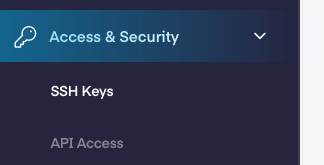
Using SSH Keys is the recommended and secure method to access your VMs. To setup your SSH Key, navigate to 'Access and Security' in the Navigation Pane, and import your SSH Keys.
Once you have the key imported, you can select that key when creating a new VM. s
### Select Server Group
Optionally select a server group for this vm to be part of. This will impact the VM's placement on a host in your virtualized cluster.
Using cloud-init
Using cloud-init allows you to customize the Virtual Machine as it boots up, such as to provision certain additional software or customization scripts.
### Assign Security Groups
Security groups allow you to limit port access to Virtual Machines. If you don't already have a Security Group configured, you can cover this later.
### Specify Metadata
Metadata attributes allow you to specify additional key-value pairs of metadata, which can be used for querying and organizing your Virtual Machines.
{% hint style="success" %}
**Success**
With this information specified, you should see the VM provision within a few minutes. You can then access the VM over the network or via its console.
{% endhint %}
## Migrate Existing VMs from VMware
If you have existing workloads that you would like to migrate onto your space.vars.product\_name cluster, [Project vJailbreak](https://github.com/platform9/vjailbreak) can help.
### Download the vJailbreak Appliance
Head over to Project vJailbreak to download the appliance image. The appliance is packaged as an OVA that you can deploy into your space.vars.product\_name environment. Note that vJailbreak should have access to your storage network to efficiently migrate VM data over during the data copy phase.
### Register your Source VMware Environment and Your New space.vars.product\_name Cluster
As your vJailbreak appliance loads, you'll see the instructions to access its user interface, where you can specify your source VMware environment information, as well as the information of your new space.vars.product\_name cluster.
### Select VMs and Schedule Migrations
With this information specified, you can now initiate migrations from vJailbreak user interface.
---
# Agent Instructions
This documentation is published with GitBook. GitBook is the documentation platform designed so that both humans and AI agents can read, navigate, and reason over technical content effectively. Learn more at gitbook.com.
## Querying This Documentation
If you need additional information that is not directly available in this page, you can query the documentation by asking a question.
Perform an HTTP GET request on the following URL with the `ask` and `goal` query parameters:
```
GET https://docs.platform9.com/private-cloud-director/2025.4/virtualized-clusters/deploying-workloads.md?ask=&goal=
```
`ask` is the immediate question: it should be specific, self-contained, and written in natural language.
`goal` is what the user is ultimately trying to achieve, the reason they need the answer. Sharing it helps GitBook give you a better, more relevant answer. A goal is most helpful when it describes the outcome the user wants rather than restating the question. For example, with `ask=how do I create an API token`, a goal like `automate deployments from our CI pipeline` lets GitBook tailor the answer to that use case.
The response will contain a direct answer to the question and relevant excerpts and sources from the documentation.
Use this mechanism when the answer is not explicitly present in the current page, you need clarification or additional context, or you want to retrieve related documentation sections.