> For the complete documentation index, see [llms.txt](https://docs.platform9.com/llms.txt). Markdown versions of documentation pages are available by appending `.md` to page URLs; this page is available as [Markdown](https://docs.platform9.com/managed-kubernetes/5.9/application-catalog/deploying-and-managing-applications.md).
# Deploying And Managing Applications
Applications can be deployed using the Apps Catalog tab of Apps Dashboard. Applications can only be deployed to clusters that have been registered with a repository.
### [Deploy an Application](https://platform9.com/docs/kubernetes/application-catalog#deploy-an-application)
To deploy an application, follow the steps noted below.
1. To begin, verify that at least one application repository (e.g., Platform9-apps, Bitnami, Argo) has been [added](https://platform9.com/docs/kubernetes/application-catalog#repository-management) and registered to your cluster
2. Once the repo has been added, navigate to the *Apps* > *Apps Catalog* tab and then search for your application. Use the repository and cluster filters if required.
3. As soon as the app is selected, click on the
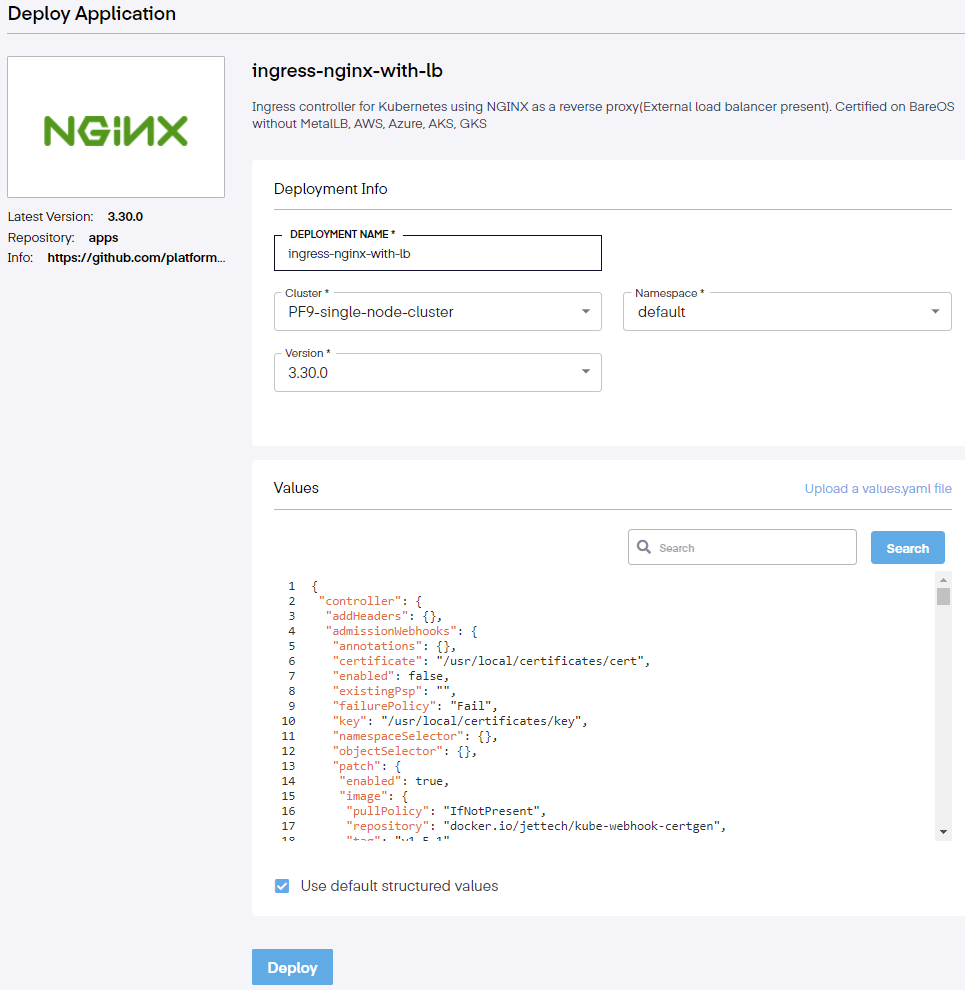
button on the application card. This opens a new screen where specific app info is required.
4. Next, provide a name for the Helm Release (a Release is an individual deployment of an app), select the target cluster, select the target name space, select a version and review the values.yaml
1. **Name:** This is the Helm Release Name used to identify a deployment of an application
2. **Cluster:** The cluster where the app will be deployed
3. **Namespace:** The Namespace within the cluster to deploy the app into
4. **Version:** The version of the application to deploy
5. **values.yaml:** Edit, upload or use the default values.yaml
5. Finally, click Deploy and the application will be deployed into the target cluster.
{% hint style="success" %}
**values.yaml**
The default values.yaml configuration **may** cause the application deployment to fail. For further information, visit the [auto$](https://github.com/platform9/pcd-docs-gitbook/blob/main/kubernetes/helm-values-yaml/README.md) page.
{% endhint %}
### [View Deployed Application](https://platform9.com/docs/kubernetes/application-catalog#view-deployed-application)
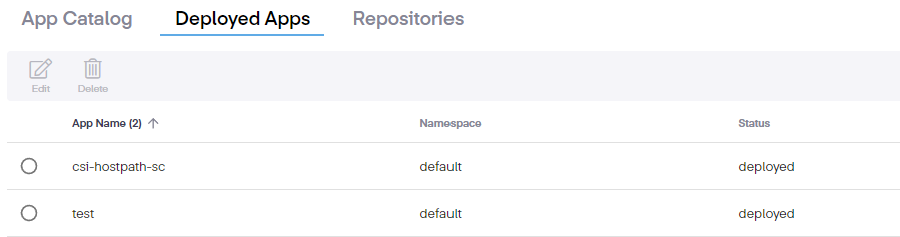
Deployed applications can be viewed in two locations, the *Apps* > *Deployed Applications* tab or when viewing the *Clusters Details* dashboard.
To view a deployed app in the Apps dashboard, follow the steps below.
1. Navigate to *Apps* > *Deployed Apps* Tab
2. Using the Table Action bar, select your cluster and the namespace where the application is running.
To view a running application from a given cluster's details dashboard, follow the steps below.
1. Navigate to the *Infrastructure* > *Clusters* tab and click the name of your cluster
2. On the *Cluster Details* dashboard, click the *Deployed Apps* tab
### [Delete an Application](https://platform9.com/docs/kubernetes/application-catalog#delete-an-application)
To delete a deployed app, navigate to the Apps dashboard and follow the steps below:
1. Navigate to *Apps* > *Deployed Apps* Tab
2. Using the Table Action bar, select your cluster and the namespace where the application is running.
3. Select the application and use the Delete action in the table action bar to delete the app.
### [Update an Application](https://platform9.com/docs/kubernetes/application-catalog#update-an-application)
To update a running applications configuration or versions use the Apps dashboard follow the steps below:
1. Navigate to Apps dashboard Deployed Apps Tab
2. Using the Table Action bar, select your cluster and the namespace where the application is running.
3. Select the application and use the Update action in the table action bar to delete the app.
4. On the *Edit Application* dashboard, update the application with your required changes.
---
# Agent Instructions
This documentation is published with GitBook. GitBook is the documentation platform designed so that both humans and AI agents can read, navigate, and reason over technical content effectively. Learn more at gitbook.com.
## Querying This Documentation
If you need additional information that is not directly available in this page, you can query the documentation dynamically by asking a question.
Perform an HTTP GET request on the current page URL with the `ask` query parameter, and the optional `goal` query parameter:
```
GET https://docs.platform9.com/managed-kubernetes/5.9/application-catalog/deploying-and-managing-applications.md?ask=&goal=
```
`ask` is the immediate question: it should be specific, self-contained, and written in natural language.
`goal` is optional and describes the broader end goal you are ultimately trying to accomplish on behalf of the user. GitBook uses it to tailor the answer towards what is most useful for that goal.
The response will contain a direct answer to the question and relevant excerpts and sources from the documentation.
Use this mechanism when the answer is not explicitly present in the current page, you need clarification or additional context, or you want to retrieve related documentation sections.