> For the complete documentation index, see [llms.txt](https://docs.platform9.com/llms.txt). Markdown versions of documentation pages are available by appending `.md` to page URLs; this page is available as [Markdown](https://docs.platform9.com/managed-kubernetes/5.8/infrastructure-dashboard-overview/cluster-node-health.md).
# Cluster Node Health
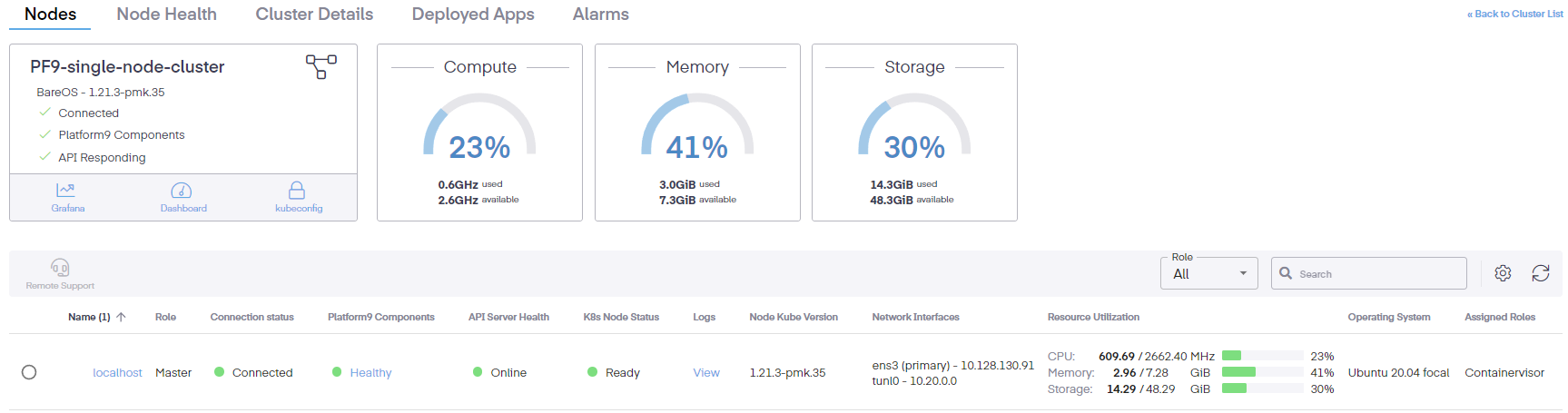
The *Infrastructure* > *Cluster* link > *Nodes* page tab shows the name of the cluster, the type of cluster, connection status of the nodes in the cluster, whether the Platform9 components are healthy, and if the API server is responding for all nodes. Additionally, a graphical overview of the attached nodes shows the compute and memory resources available, along with the storage space available on all the nodes. This view also provides links to Grafana, the kubernetes dashboard, the kubeconfig download config, and if the radio box of a cluster is selected, it allows for remote support to be enabled. Lastly, we have a dropdown box which allows us to select the master or worker nodes.
The type of information shown in each column can be easily modified by clicking on the gear icon on the right side of the page. Selections include the following editable column information:
* Name – The name of the node
* Role – Defines the type of role the node plays in the cluster; e.g., master or worker node.
* Connection status – Shows the connection status to the management plane
* Platform9 Components – Displays the health of the PMK components
* API Server Health – Confirms the API server is responding on all nodes
* K8s Node Status – Details the Kubernetes node status
* Logs – Shows a link to the log file generated by the pf9-kube components.
* Node Kube Version – Defines the Kube version on the node
* Network Interfaces – Provides connection information of the node
* Resource Utilization – Displays the CPU, Memory, and Storage information for the node
* Operating System – Exposes the OS running on the node
* UUID – Presents the universally unique identifiers (UUID) of the node within the cluster
* Assigned Roles – Defines the role of the node.
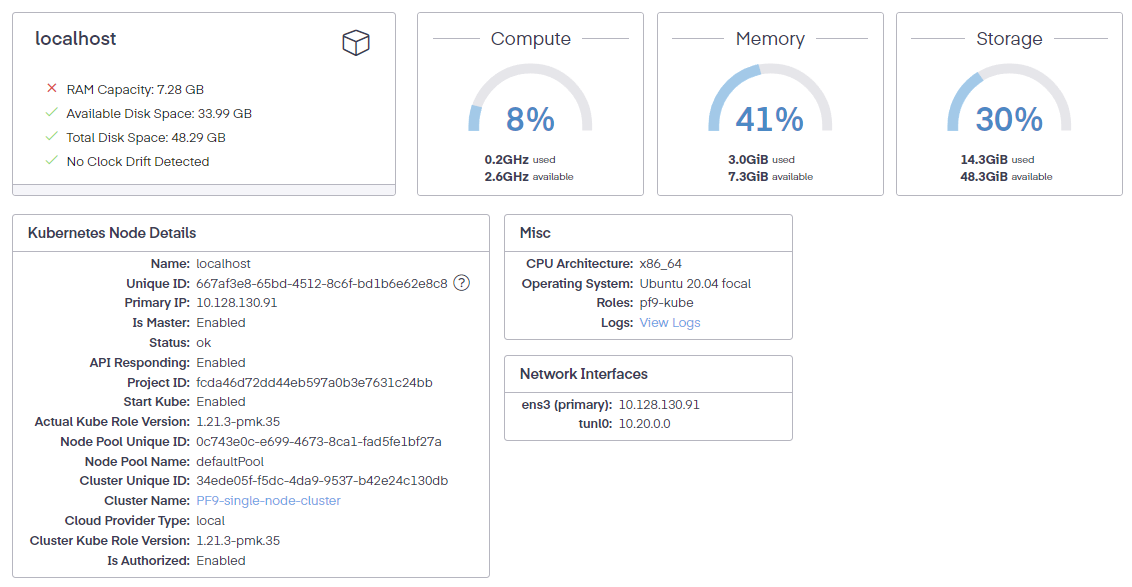
Clicking on an individual node provides even more in-depth information about the node and other associated details, including network interfaces and various other miscellaneous specifics.
---
# Agent Instructions
This documentation is published with GitBook. GitBook is the documentation platform designed so that both humans and AI agents can read, navigate, and reason over technical content effectively. Learn more at gitbook.com.
## Querying This Documentation
If you need additional information that is not directly available in this page, you can query the documentation by asking a question.
Perform an HTTP GET request on the following URL with the `ask` and `goal` query parameters:
```
GET https://docs.platform9.com/managed-kubernetes/5.8/infrastructure-dashboard-overview/cluster-node-health.md?ask=&goal=
```
`ask` is the immediate question: it should be specific, self-contained, and written in natural language.
`goal` is what the user is ultimately trying to achieve, the reason they need the answer. Sharing it helps GitBook give you a better, more relevant answer. A goal is most helpful when it describes the outcome the user wants rather than restating the question. For example, with `ask=how do I create an API token`, a goal like `automate deployments from our CI pipeline` lets GitBook tailor the answer to that use case.
The response will contain a direct answer to the question and relevant excerpts and sources from the documentation.
Use this mechanism when the answer is not explicitly present in the current page, you need clarification or additional context, or you want to retrieve related documentation sections.