> For the complete documentation index, see [llms.txt](https://docs.platform9.com/llms.txt). Markdown versions of documentation pages are available by appending `.md` to page URLs; this page is available as [Markdown](https://docs.platform9.com/managed-kubernetes/5.13/bareos-what-is-bareos/cluster-internals.md).
# Cluster Internals
This article describes several of the service elements that constitute a notable portion of the Platform9 components. In addition to the pf9-hostagent, pf9-comms, and pf9-nodelet services, Platform9 also installs other services that compromise a Kubernetes Cluster. The [Host Internals](https://platform9.com/docs/v5.3/PES/host-internals) page describes these elements in additional detail.
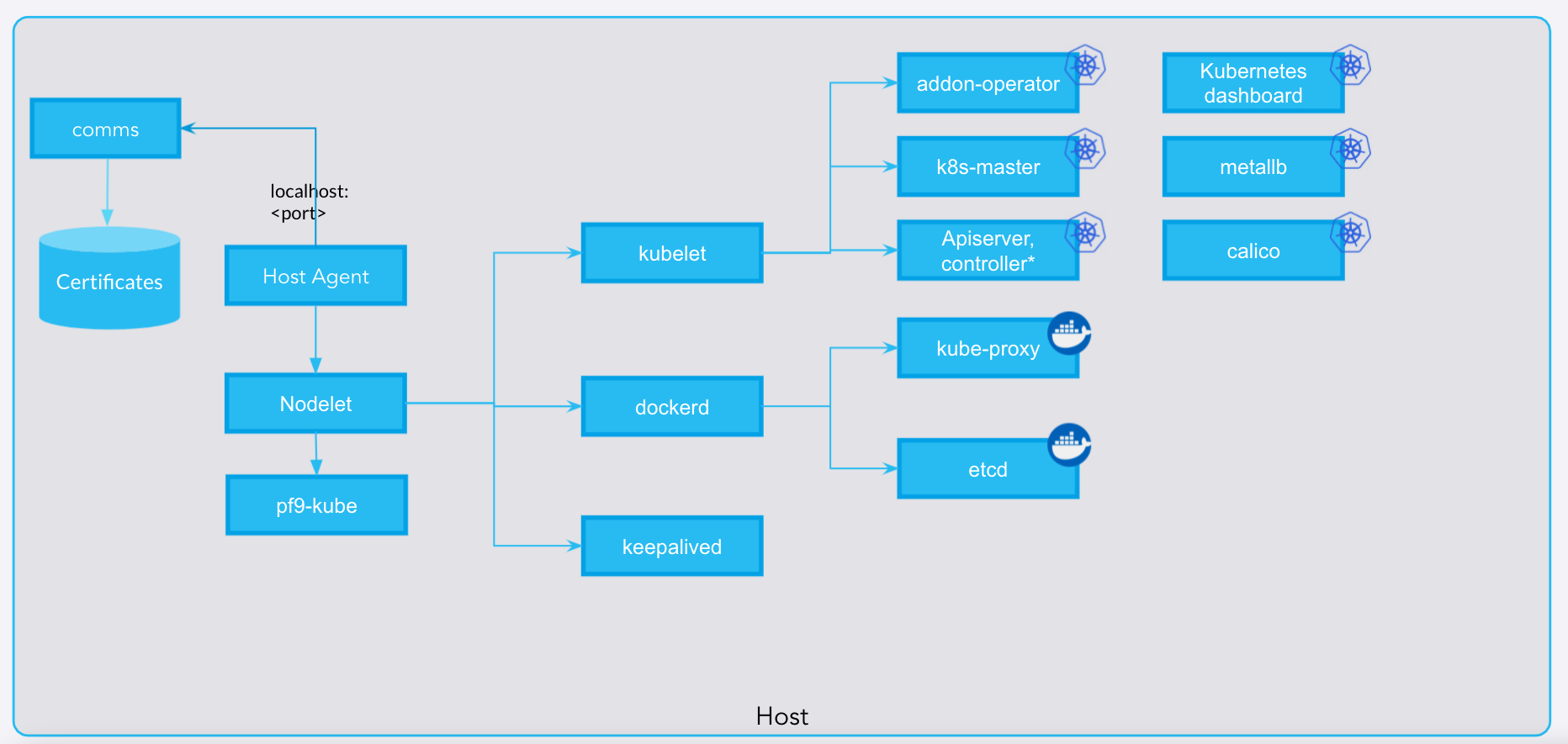
For further details on nodelet, please review the [Nodelet ](https://platform9.com/docs/kubernetes/nodelet)page filed under the PMK documentation. The following diagram illustrates a high-level view of the different services, containers, and processes involved in creating the cluster. In the diagram below, note the hierarchy of various components.
* **pf9-hostagent:** This is the prominent service that is responsible for initiating nodeletd.
* **nodeletd:** The nodeletd functions on the worker and master differ slightly. For example, the following diagram shows a master configuration. It starts these three primary services:
* kubelet
* dockerd
* keepalived
* **dockerd**: This process creates containers via the docker daemon
* **keepalived**: Bare metal systems primarily use keepalived to provide highly available IP addresses between the different Kubernetes API servers.
* **kubelet**: This Kubernetes component runs as needed as a systemd unit file. It initiates various containers like the k8s-master, apiserver, controller, scheduler, etc. It also starts the addon-operator, which in turn launches other critical system addons.
* **kube-proxy, etcd**: both of these components run as a docker container.
## Master - Worker Connections
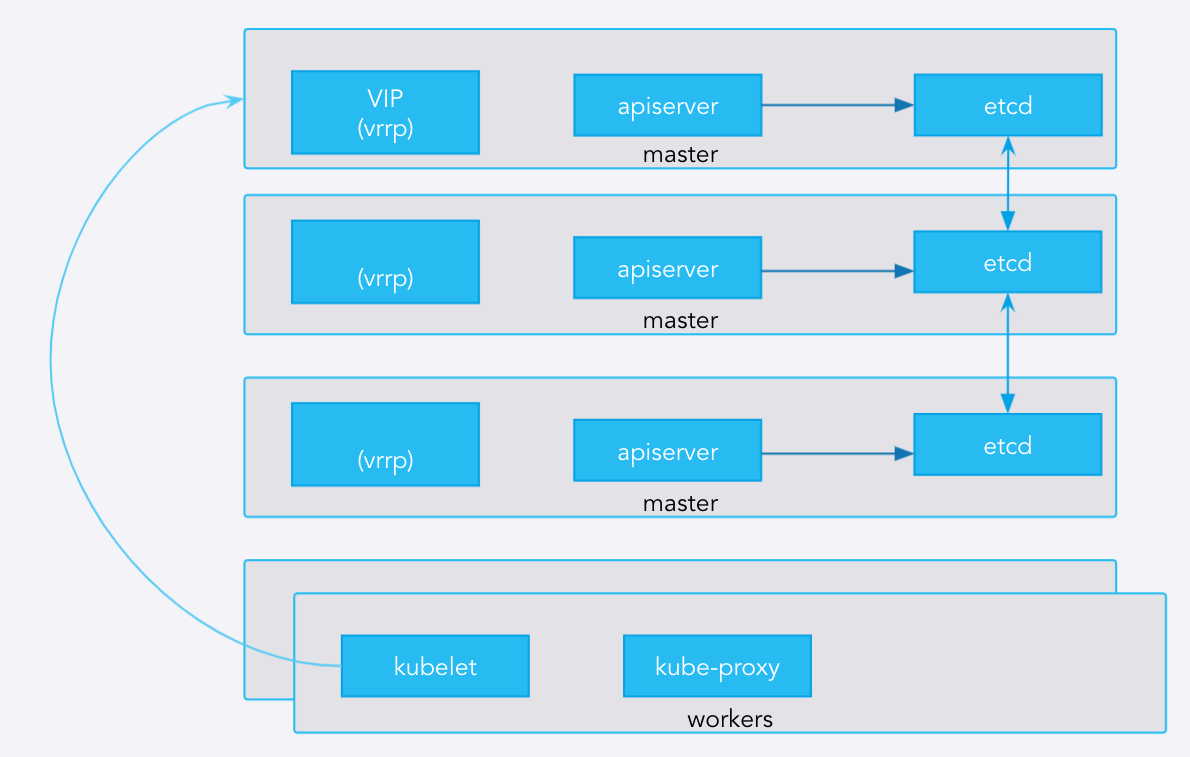
The following diagram illustrates the different networking connections between masters and workers.
* **etcd**: etcd creates clusters and allows them to talk, if it exists in a mesh network.
* **apiserver**: The apiserver on each master talks to the other corresponding etcd processes on each localhost
* **VIP**: A virtual IP (or VIP) is created and is maintained by keepalived using the VRRP protocol. Workers use the VIP to communicate with the masters. If a node fails, the VIP will move between the master nodes.
* **kubelet**: The kubelet on each worker node will connect to the VIP (and hence, each of the servers).
---
# Agent Instructions
This documentation is published with GitBook. GitBook is the documentation platform designed so that both humans and AI agents can read, navigate, and reason over technical content effectively. Learn more at gitbook.com.
## Querying This Documentation
If you need additional information that is not directly available in this page, you can query the documentation by asking a question.
Perform an HTTP GET request on the following URL with the `ask` and `goal` query parameters:
```
GET https://docs.platform9.com/managed-kubernetes/5.13/bareos-what-is-bareos/cluster-internals.md?ask=&goal=
```
`ask` is the immediate question: it should be specific, self-contained, and written in natural language.
`goal` is what the user is ultimately trying to achieve, the reason they need the answer. Sharing it helps GitBook give you a better, more relevant answer. A goal is most helpful when it describes the outcome the user wants rather than restating the question. For example, with `ask=how do I create an API token`, a goal like `automate deployments from our CI pipeline` lets GitBook tailor the answer to that use case.
The response will contain a direct answer to the question and relevant excerpts and sources from the documentation.
Use this mechanism when the answer is not explicitly present in the current page, you need clarification or additional context, or you want to retrieve related documentation sections.